
Most business owners approach webinars like they’re hosting the online equivalent of a block party or the “Field of Dreams”, hoping that if they build it, everyone will come.
If you tried that already, then you know how it turns out — crickets.
There’s a better approach. One that we use all the time to transform our client’s businesses from 6-figure successes to 7-figure dreams-come-true.
To see those kinds of results, your webinar marketing strategy should focus on scaling up whatever is currently working best, not getting the most possible attendees.
In other words — if you don’t have a funnel that’s already converting, webinars aren’t going to magically fix your problems.
Webinars are not a silver bullet, and they’re definitely not the place to start if you’re completely new to marketing.
We invite all of our clients to think of webinars as a growth accelerator for everything that’s currently working for you, not as an end-all-be-all sales channel.
If that’s starting to sink in and make sense, read on. This article gives the foundational insights you need to build a successful webinar strategy.
A Better Way To Think About Webinars
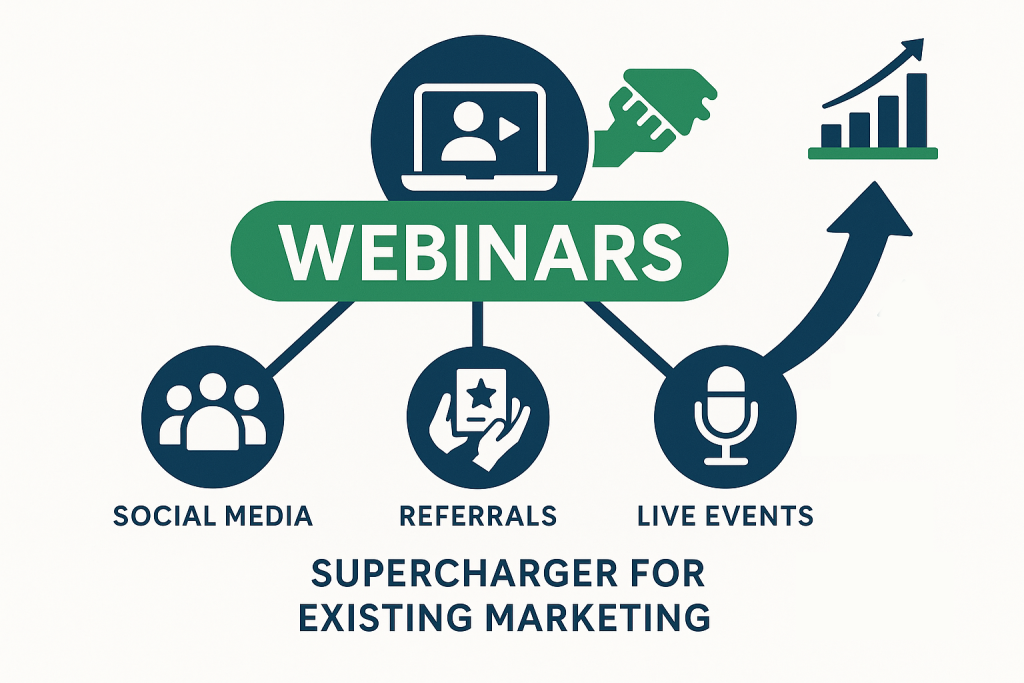
Instead of using webinars as standalone events to attract customers from thin air, think of them as a supercharger for your existing marketing engine.
Maybe most of your customers come from conversations you started on social media. Maybe it’s live events you attend or referrals from your network.
Either way, webinars work best as a way to multiply the effects of what’s already working.
That’s not to say webinars don’t have their own unique advantages — because they absolutely do. Here’s what makes them so powerful when used correctly:
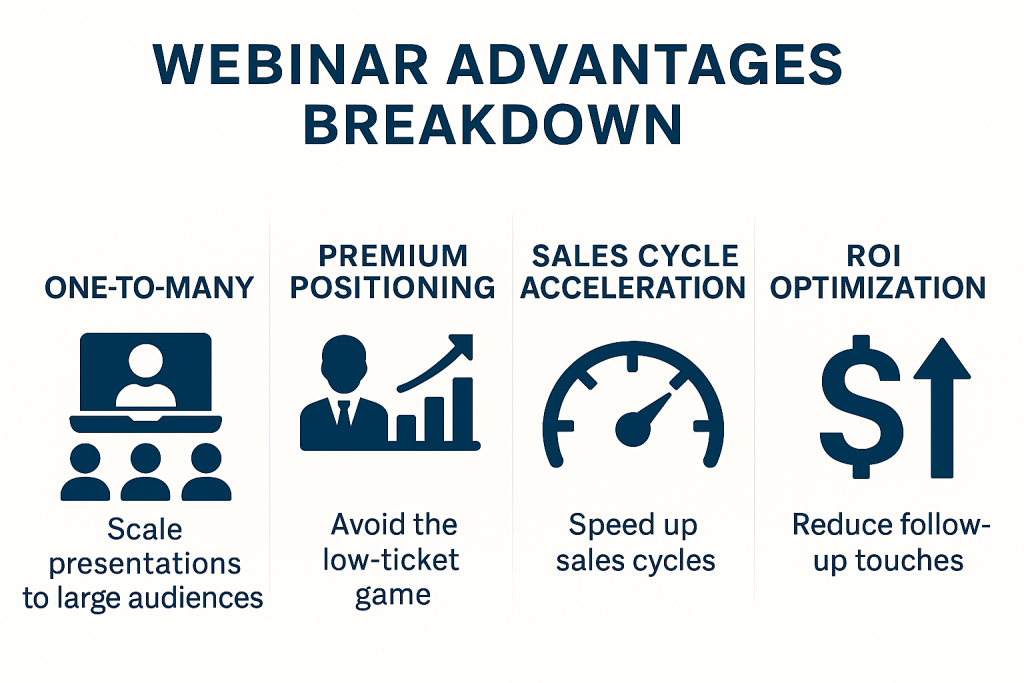
- Webinars are one-to-many, allowing you to engage directly with a large audience without the logistical nightmare of coordinating in-person events or shipping costs. You can reach 5 people or 500 people with the same amount of effort, and they can ask questions in real-time.
- Webinars help you avoid the “low-ticket game” that so many businesses get trapped in — arbitraging ad costs with low-quality leads that never convert to anything meaningful. Instead of competing on price with a bunch of $27 courses, you can position yourself as the premium solution.
- Webinars speed up your sales cycle by showing prospects exactly how your process works. There’s something powerful about live demonstrations that isn’t quite the same when explained through emails or blog posts. When people can actually see you, trust builds faster.
- Webinars reduce the need for repeated sales touches or endless follow-up email sequences. Instead of sending 12 nurture emails hoping someone will book a call, invite prospects to a webinar. You can then address their objections and demonstrate how your offer helps them personally, all at once.
Most importantly, webinars offer the highest Return on Investment (ROI) as a lead generation method for scaling your business.
The real magic is that they don’t just generate leads — they improve lead quality, resulting in registrants and booked calls with the lowest acquisition cost and highest intent compared to other marketing campaigns.
Once you’ve proven your webinar converts, they’re incredibly easy to scale. You can do that by simply:
- Increasing ad spend
- Involving referral partners
- Automating portions of the process.
We’ve seen clients go from a few dozen registrants to hundreds or thousands of booked calls per quarter for high-ticket services. Get our complete blueprint for launching a successful lead generation webinar to see exactly how we achieve these results for our clients.
But here’s where most people mess up: they try to use webinars as a replacement for building a solid foundation for lead generation.
What you need in place before you build a webinar strategy
If you’re completely new to lead generation webinars are not the right place to start. Full stop.
I know that’s not what you want to hear, especially if you’ve been watching YouTube videos about “passive income webinars” that promise to make you rich while you sleep (spoiler alert: that’s not how this works).
The strategy presented here hinges on having a growing company with established product-market fit.
That means people must already be buying your product or service. You need to know your customer base like the back of your hand and have experience selling to them.
Selling something for the first time is not likely to happen through a webinar — you first need consistent lead flow to test against.
You should also not dive into a webinar campaign as a means to replace your other lead generation methods. That’s like removing the engine from your car because you want to install a turbocharger.
Before you even think about webinars, get crystal clear about what’s already working in your marketing.
Which marketing campaigns and channels are your current top performers?
What’s actually bringing in high-quality leads that convert to paying customers?
Above all, know that webinar lead generation is not passive. It requires ongoing presentations, performance monitoring, and constant fine-tuning.
If you’re looking for a business that takes minimal time to run, this isn’t it.
You should already have:
- A steady lead flow
- A healthy email list
- The ready and willingness to get aggressive about growing
Here’s a quick litmus test: Are you comfortable writing your own copy?
If the answer is, ‘Yes, I’m even reluctant to let a pro write it,’ then that indicates a strong understanding of your target audience.
Next, see if you can check these 3 boxes:
- You know your customer.
- You’ve sold your product or service to them.
- You have enough customers in place that scaling is possible.
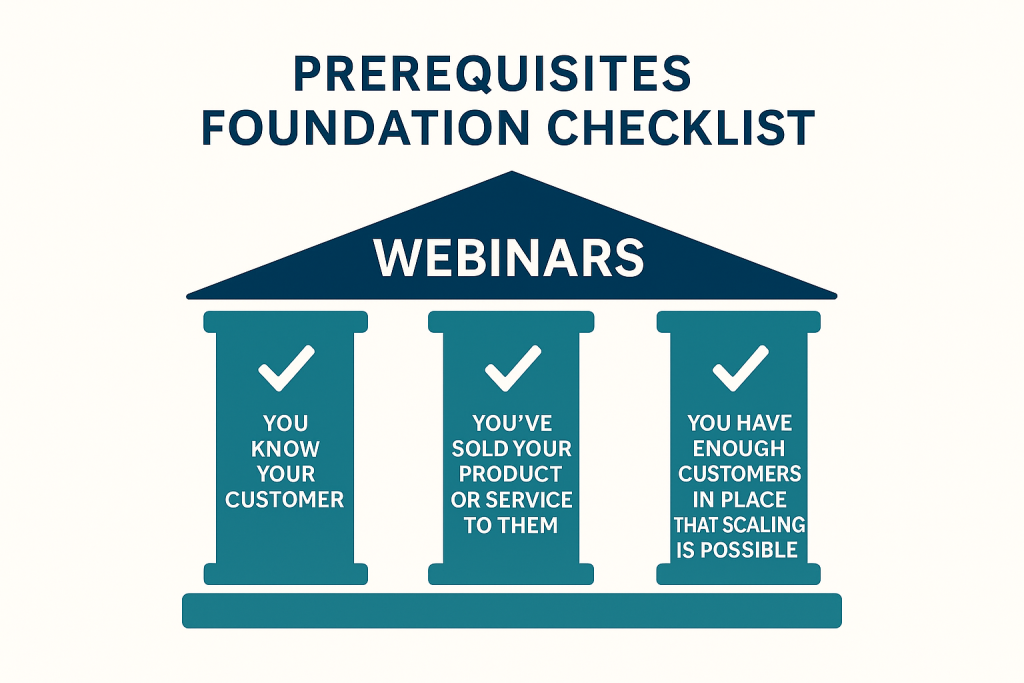
If you can’t check all three boxes, focus on building that foundation first.
Interconnecting a Webinar Strategy With Your Marketing Funnel
There are 2 major steps you need to take to interlace a webinar strategy with your existing sales and marketing funnel.
- Determine what’s already driving customers through the door
- Identifying where your sales and marketing funnel falls short
Determine Your Top-Performing Channels
Before you plan your first webinar, look at your best sources of leads or channels that are currently responsible for bringing you the most revenue. Not the most traffic, not the most social media likes or engagement — revenue.
This means digging into your analytics and being brutally honest about what’s actually moving the needle in terms of leads.
Maybe your LinkedIn outreach is converting at 15%, but your Facebook ads are only converting at 2%.
Maybe your referral program brings in three high-value clients per month, but your content marketing hasn’t generated a single sale.
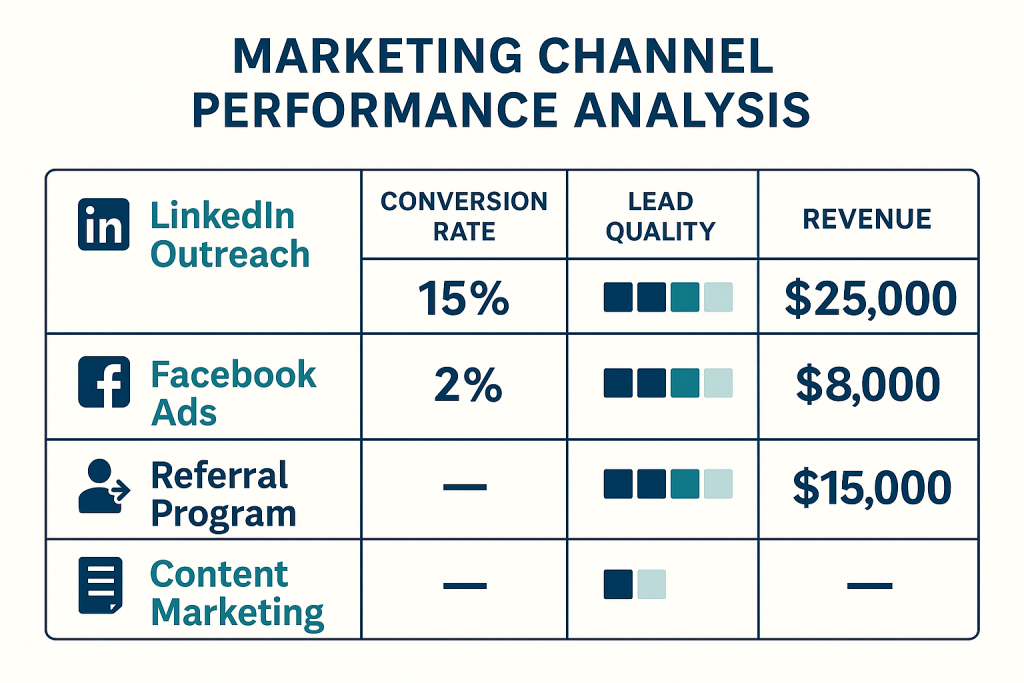
The goal here is to find out exactly what lead sources your webinars should amplify.
Identify Funnel Gaps
Once you know what’s working, find out where webinars best fit into your existing ecosystem.
For instance, they might replace low-ticket offers or direct-to-video sales letter (VSL) funnels.
Or, maybe you’ve been stuck in the launch cycle without consistent leads coming in.
Maybe you simply have limited time and want to maximize your time and go beyond your “natural” growth limit.
The point is that you get to know the plateau you’re currently on. A good question to ask yourself is: Where am I working hardest but not seeing proportional revenue increases?
How To Plan a Webinar Marketing Strategy
Once you’ve got an idea of how webinars might play into your current funnel, the creative gears start turning.
Now is the time to start actually building the strategy you plan to implement. It starts with clear goals and a budget.
Step 1: Set Realistic Goals and Budgets
This is the most overlooked but most important step in the entire process. Set clear and realistic expectations, along with a budget that makes sense for your timeline.
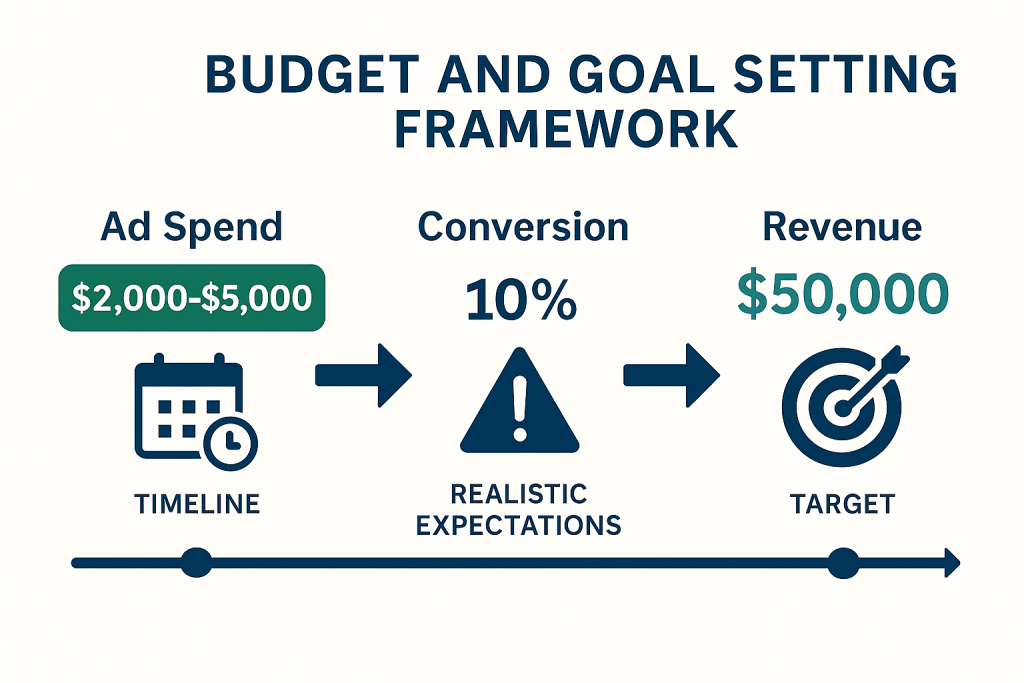
For advertising, we typically recommend starting with at least $2,000-$5,000 in ad spend to get meaningful data. However, your budget should also align with your average customer value and business goals.
You need to define your own goals and expectations as well as those of your clients or stakeholders.
For example, if you’re running a webinar campaign for a client selling online sales training courses, you might set a goal to get 500 registrants and a strong return on ad spend.
The goal you set with your client — hence, their expectation — is to convert at least 10% of attendees into paying customers and generate $50,000 in new revenue.
That said, accept that not everything will work out right away. Webinars, like any marketing channel, require plenty of testing and optimization.
Another reason to set realistic expectations at the start is that it prepares you mentally, strategically, and financially for the long game. If you expect 1,000 registrants and 50 sales from your first webinar, you’re probably setting yourself up for disappointment.
The key is to solidify your content ideas, budget, and expectations into a single clear roadmap before you start building anything. This prevents scope creep and keeps you focused on what matters.
Step 2: Tailor Content to Your Target Audience
Always tailor the webinar topic and presentation to your target market, regardless of what trending tactics you see other people using. What works for a fitness coach selling $97 programs won’t work for a consultant selling $50,000 engagements.
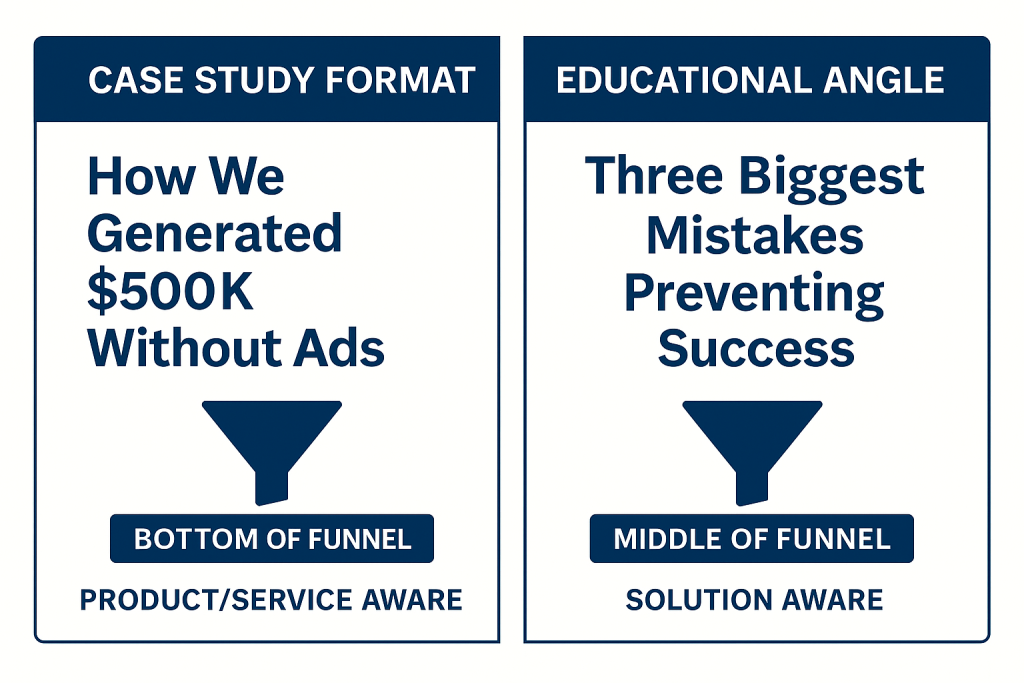
Think bottom-of-the-funnel content strategy when starting out. Meaning, content that’s designed for people who are ready to buy, not research or who have just come into contact with your brand.
You want an audience that’s problem aware and ideally solution and product/service aware. They should know who you are and have some idea of what you do.
The content should be built around their pain points and how your product or service helps them solve those problems. By keeping it simple and bottom-of-the-funnel focused, you’ll drive actual sales instead of a bunch of traffic that never does anything for your business.
Step 3: Choose Your Webinar Topic and Format
Now that you know who you help, what their problems are, and how you fix them, you’re ready to choose a webinar topic. Here are some tactics that consistently work well:
The Case Study Format
This does well to show how you achieved an amazing result without doing something else.
For example: “How We Generated $500K in New Revenue Without Spending a Dime on Ads” or “The Client Who Doubled Their Team’s Productivity Without Hiring Anyone New.”
The Middle-of-the-Funnel Approach With an Educational Angle
This can also work, but always within the context of the audience’s pain points and your solution.
Think: “The Three Biggest Mistakes Preventing You From [Desired Outcome]” or “Why Most [Industry] Strategies Fail (And What to Do Instead).”
Most importantly, do not use top-of-the-funnel strategies to “build brand awareness” when starting!
Save the thought leadership content for when you have a proven webinar that converts. Your first webinar should be laser-focused on people who are ready to buy.
Step 4: Select the Right Platform
Popular webinar platforms include Demio, LiveStorm, WebinarJam, and Webinar Kit. Selecting your platform of choice should be mostly based on its ability to automatically connect to your other systems.
Mainly, it should integrate with your Customer Relationship Management (CRM) or marketing automation platform. If it doesn’t integrate directly, you’ll need to use an automation platform like Zapier to connect everything.
This is also a good time to consider your entire tech stack. Here’s a basic stack for launching a webinar campaign:
- Landing Page Builder
- Email Marketing Provider
- CRM
- Call Booking/Meeting Scheduler
- Video Hosting Provider
- Webinar Platform
- Automations and Ads Platform
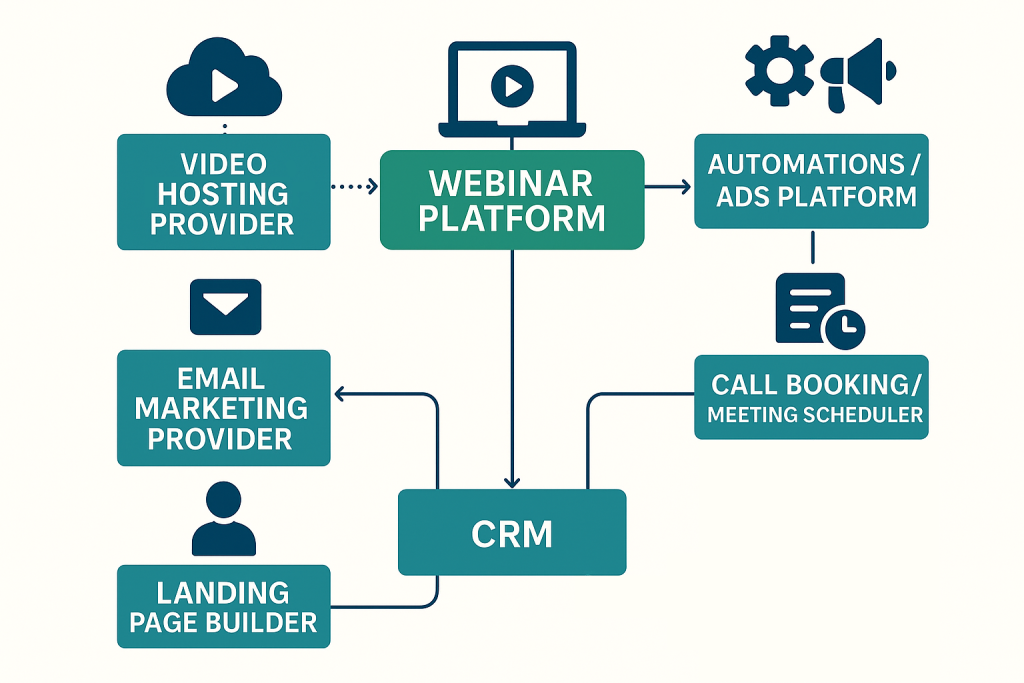
Everything needs to work together as seamlessly as possible. Otherwise, you’ll spend way more time troubleshooting than presenting.
Step 5: Plan Your Webinar Content
Think interactive elements and engagement tactics.
Plan to use polls and Q&A sessions to maintain engagement throughout your presentation. These interactive elements also provide valuable insights you can use to tailor your content in real-time.
For example, during a webinar you might poll the attendees, asking about their biggest challenge. If most select “content creation,” you’ll know how to shift the presentation, focusing on practical content creation tips.
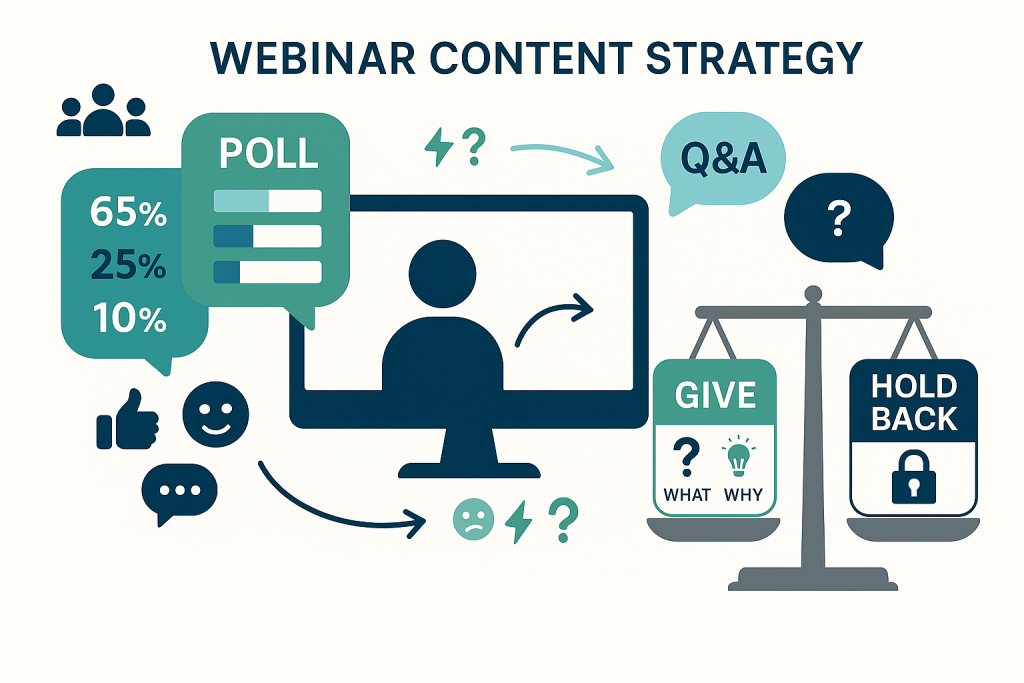
The goal here is to choose content that helps you build a sense of community around your webinar. Encourage participation and make attendees feel like they’re part of something special, not just watching a glorified sales pitch.
Don’t Over-Teach
In the presentation, don’t over-teach. If you have a huge list of things to say, you should shorten it. This is where most people go wrong — they try to cram everything they know into a single presentation.
Remember, speak to the pain points. Explain your solution. Then give away just enough of your process to show a connection between the audience’s problem and your solution.
It’s a fine line between providing valuable information and compelling them to buy. A good way to think about it is to give them the “what” and the “why,” but save the “how” for your paid program.
Step 6: Plan Your Webinar Promotion
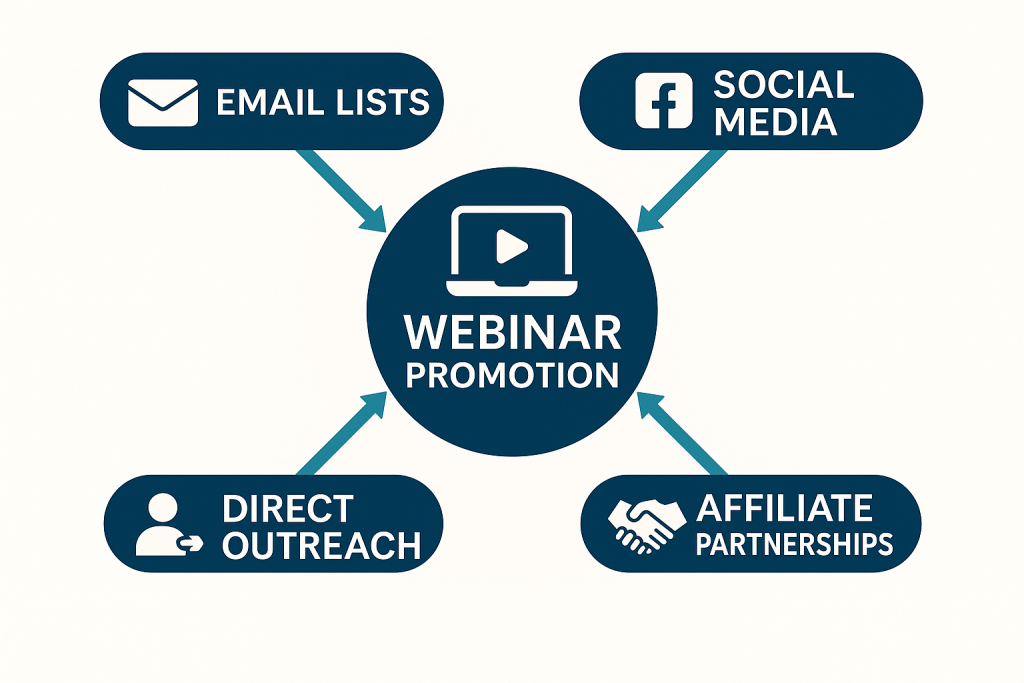
The easiest (and recommended) way to start is by promoting through your email list first — it’s often the lowest hanging fruit with zero acquisition cost.
But don’t just send one email and hope for the best. Prime your email list before inviting them to the webinar with valuable content that builds anticipation.
If you have a sales team or list of leads, reach out directly with a personal invitation, especially for high-ticket offers. A personal touch often outperforms mass marketing for expensive services.
Be sure to leverage your social media presence, too. You can learn how to do that with our complete step-by-step guide for promoting webinars on Facebook.
Create content that gets engagement and has a clear call to action. Facebook’s “Create Event” feature is great for setting up a dedicated page. Post in as many places as you ethically can where you have a standing presence.
Do NOT create a bunch of new social media profiles just for the webinar. Instead, build up goodwill in groups you’re already part of rather than spamming with your event.
Last, create pre-webinar buzz by announcing that something special is coming soon. Use teaser posts and countdowns to build anticipation — people love being part of something exclusive.
Partner Collaboration and Affiliates
Promotion is a good time to consider strategic partners and affiliates who could send you registrants for no upfront cost. Ask yourself: who in your network has a complementary business you can connect with as an affiliate? What kind of kickback could you give them for helping you out?
This is often the most overlooked promotional strategy, but it can be incredibly effective.
Step 7: Optimize Every Page and Stage of Your Webinar Funnel
Your webinar registration page should headline with an outcome or benefit, often in a case study or process overview format. After the headline, use bullet points to outline what attendees will learn.
You could also offer something complimentary for opting in — a resource that doesn’t cannibalize your core offer but moves prospects along the process. This could be a checklist, template, or bonus training.
Your confirmation emails should include a CTA to take immediate action. Don’t just confirm their registration — give them something to do that increases engagement and investment.
The webinar room or video page is where you give the presentation and should also have a clear CTA. Keep the design clean and distraction-free so attendees focus on your content.
The replay page should only include the video with a prominent button or CTA to book a call or buy. Remove navigation and other distractions — this page has one job.
The next steps or book-a-call page should use a benefit-based headline and a non-pushy call to action, like offering a no-pressure discovery call. Load this page with testimonials, reviews, and case studies to build credibility.
The second confirmation page after booking a call should thank them and include a video priming them for the one-on-one conversation. Set expectations and provide value even before the call happens.
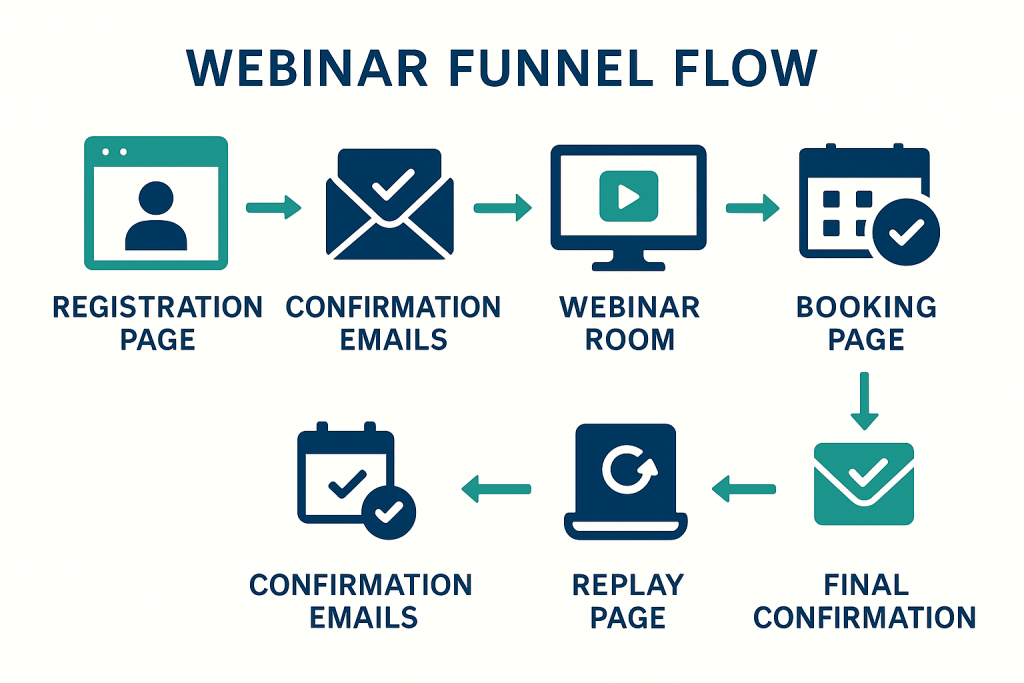
Keep your pages simple for a better prospect experience. Every additional element on the page should either build trust or drive the desired action — everything else is just distraction.
Step 8: Pre-, During-, and Post-Webinar Nurturing
Here’s something most people don’t realize: most conversions happen before and after the webinar, not during. Your nurture sequence is often more important than the webinar content itself.
Use a “book a call” CTA as the main conversion metric at every touchpoint. Whether someone attends live, watches the replay, or never shows up, they should always have a clear next step.
Get the most possible out of email. Follow up after the initial invitation with varied subject lines and opening paragraphs. Don’t just send the same “reminder” email five times — provide different angles and value in each message.
The replay page is crucial for post-webinar nurturing. Many of your best prospects will watch the replay rather than attend live, so treat this page with the same importance as your live presentation.
Have a post-webinar email campaign that’s different for attendees (emphasizing the offer) and non-attendees (providing the replay). Tailor your messaging based on their current level of engagement.
Here are a couple of examples of what I mean:
- For attendees who stayed until the end, you send a personalized email thanking them for participating and highlight a special, limited-time offer related to the webinar topic.
- For those who registered but did not attend, you send an email with a link to watch the webinar replay and a softer CTA, inviting them to reach out with questions or learn more when they’re ready.
This way, each group receives messaging that matches how engaged they were with your event.
During the webinar, redirect attendees to a conversion page immediately after the webinar ends, and send out the replay within an hour with a bold CTA. Speed matters in follow-up.
Step 9: Closing The Deal
Throughout the process, the main conversion goal is often to **book a call** rather than make an immediate purchase. This is especially true for high-ticket offers where people need to speak with someone before buying.
Make sure every touchpoint throughout the entire funnel pushes towards the conversion goal.
Ready To Build Your Webinar Strategy With Be Known?
If you don’t like doing webinars or lack the time to set them up properly, Be Known exists to help. We handle the tech side, including strategic planning, tech setup, business automation, and advertising management.
We can also handle copywriting, or help you write it by giving strategic insight and graphic design assistance. You probably know your audience better than anyone.
You can think of us as “the tech team that helps you make money” or the operational professionals behind your funnel.
In closing, webinars aren’t magic, but they’re incredibly powerful when used correctly. They’re not for everyone, and they’re definitely not a get-rich-quick scheme. But if you have a solid foundation, know your market, and are ready to scale, they might just be the growth accelerator your business needs.